Key Testing Methods for Power Cables Under IEC Standards
Time: 2026-01-27 09:17:44
Source: Henan Province Jianyun Cable Co., Ltd.
By Jianyun Cable – Professional Manufacturer of Quality Electrical Cables
1. Introduction to IEC Testing Methods for Power Cables
Power cable testing under IEC standards is the definitive process to verify that cables meet safety, performance, and durability requirements for low, medium, and high voltage applications. The International Electrotechnical Commission (IEC) provides a comprehensive framework of testing methods that manufacturers must follow to ensure reliable power transmission in residential, industrial, utility, and renewable energy projects. This technical article details the major testing methods from key IEC standards (60502, 60840, 62067, 60331, 60332, 61442, etc.), explaining procedures, acceptance criteria, and their significance in 2025.
2. Classification of IEC Cable Tests
IEC standards divide testing into three categories:
-
Routine Tests: Performed on every manufactured length – quick checks of basic integrity.
-
Sample Tests: Carried out on representative samples from production batches – verify construction and material properties.
-
Type Tests: Conducted once on a new design (or after major changes) – prove full compliance with performance claims.
3. Electrical Testing Methods
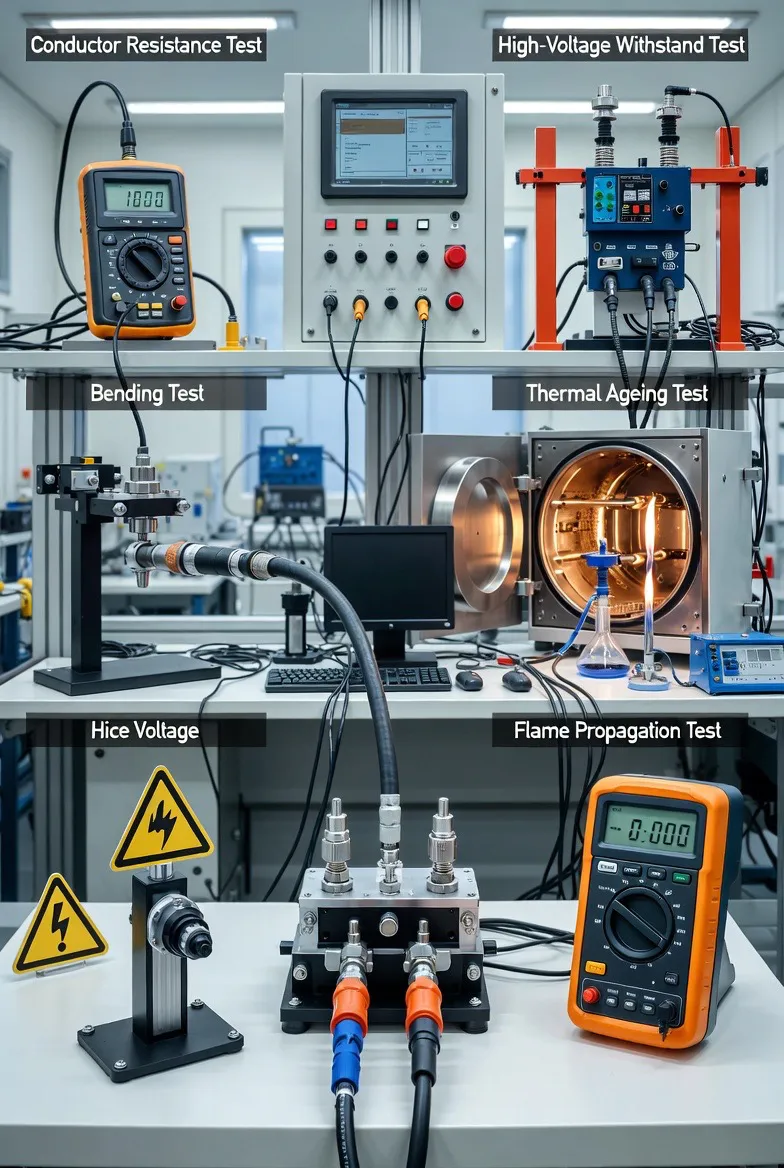
These tests confirm insulation quality, conductor performance, and absence of defects:
-
Conductor Resistance Test (IEC 60228): DC resistance measured at 20°C; must not exceed specified values (e.g., 18.1 Ω/km for 1.5 mm² copper).
-
High-Voltage (HV) Withstand Test: AC or DC applied for set duration (e.g., 4U₀ AC for 15 min on XLPE LV cables; 2.5U₀ for 30 min on MV).
-
Partial Discharge (PD) Test (IEC 60270): Applied at 1.5–2U₀; acceptance ≤5 pC for MV/XLPE cables – critical for detecting voids and defects.
-
Tan δ (Dissipation Factor) Measurement: Measures dielectric losses; typical limit ≤4×10⁻³ at U₀ for XLPE.
-
Insulation Resistance Test: Minimum values (e.g., >1000 MΩ·km for XLPE at 20°C).

4. Mechanical & Dimensional Testing Methods
These verify the cable can withstand installation and service stresses:
-
Bending Test (IEC 60502 / 60811): Cable bent around a mandrel (8–12× outer diameter) – no cracks or damage after voltage test.
-
Tensile Strength & Elongation at Break (IEC 60811-501): Insulation/sheath tested before & after ageing; min values e.g., 12.5 N/mm² & 150% for XLPE.
-
Armour Tensile Strength & Elongation: Steel wire must meet min breaking load and galvanizing requirements.
-
Sheath Thickness & Overall Diameter Measurement: Ensures compliance with nominal values (± tolerances).
5. Thermal & Ageing Testing Methods
These simulate long-term service conditions:
-
Thermal Ageing in Air Oven (IEC 60811-401): 7–14 days at elevated temperature (e.g., 135°C for XLPE); retention of tensile/elongation ≥75%.
-
Heat Shock Test: 5 hours at 150–180°C; no cracking or flowing.
-
Hot Set Test (IEC 60811-507): Cross-linking verification for XLPE/EPR – elongation under load ≤175%, permanent set ≤25%.
-
Pressure Test at High Temperature: Insulation indentation resistance under load at operating temperature.
6. Fire Performance & Reaction-to-Fire Testing Methods
Mandatory under CPR (EN 50575) and IEC:
-
Flame Propagation – Single Cable (IEC 60332-1-2): Vertical flame; char length ≤425 mm.
-
Flame Propagation – Bunched Cables (IEC 60332-3): Categories A–D; limited flame spread in vertical ladder test.
-
Circuit Integrity under Fire (IEC 60331): Maintains functionality at 750–1000°C for 90–180 min.
-
Smoke Density Test (IEC 61034): Light transmittance ≥60% for low-smoke cables.
-
Halogen Acid Gas & Conductivity Test (IEC 60754): Low acid emission for LSZH cables.
7. Special & Environmental Testing Methods
-
Water Penetration Test (IEC 60502 Annex F): 24-hour water immersion under voltage – no breakdown.
-
UV Resistance Test (IEC 60811-505): For outdoor cables – no cracking after 720 hours exposure.
-
Oil & Chemical Resistance (IEC 60811-404): Immersion in IRM 902 oil – retention ≥60% properties.
-
Weathering Test (IEC 60811-505): Xenon arc for sheath durability.
8. Summary Table: Key IEC Testing Methods & Requirements
|
Test Category
|
Main IEC Standard
|
Test Name
|
Test Type
|
Typical Acceptance Criteria
|
|
Electrical
|
IEC 60270 / 60502
|
Partial Discharge
|
Routine / Type
|
≤5 pC at 1.5–2U₀
|
|
Electrical
|
IEC 60502 / 60840
|
HV AC Withstand
|
Routine
|
No breakdown at 2.5–4U₀
|
|
Mechanical
|
IEC 60811-501 / 505
|
Tensile & Elongation
|
Sample
|
≥12.5 N/mm² & 150% (XLPE)
|
|
Thermal
|
IEC 60811-401 / 507
|
Hot Set Test
|
Sample
|
Elongation ≤175%, set ≤25%
|
|
Fire
|
IEC 60332-1-2
|
Single Flame
|
Type
|
Char ≤425 mm
|
|
Fire
|
IEC 60331-21
|
Circuit Integrity
|
Type
|
90 min at 750°C
|
9. Final Thoughts
IEC testing methods form the global benchmark for verifying power cable quality and safety. From routine conductor resistance checks to rigorous type tests like partial discharge, fire propagation, and thermal ageing, each method plays a vital role in preventing failures and ensuring decades of reliable service. Manufacturers and users who fully understand and implement these testing methods deliver cables that meet the highest international expectations.
Looking for power cables rigorously tested to the latest IEC standards? Contact Henan Province Jianyun Cable Co., Ltd. – your trusted source for certified, high-reliability electrical power cables.