Keep up to date with our latest company news and relevant industry knowledge.
Time: 2026-07-09 07:35:45 Source: Henan Province Jianyun Cable Co., Ltd.
Solar cables must operate outdoors for more than 25 years while resisting UV radiation, high temperature, humidity, ozone, wind, sand, and mechanical stress. To ensure long-term safety and reliability, photovoltaic cables are usually designed according to strict international standards.
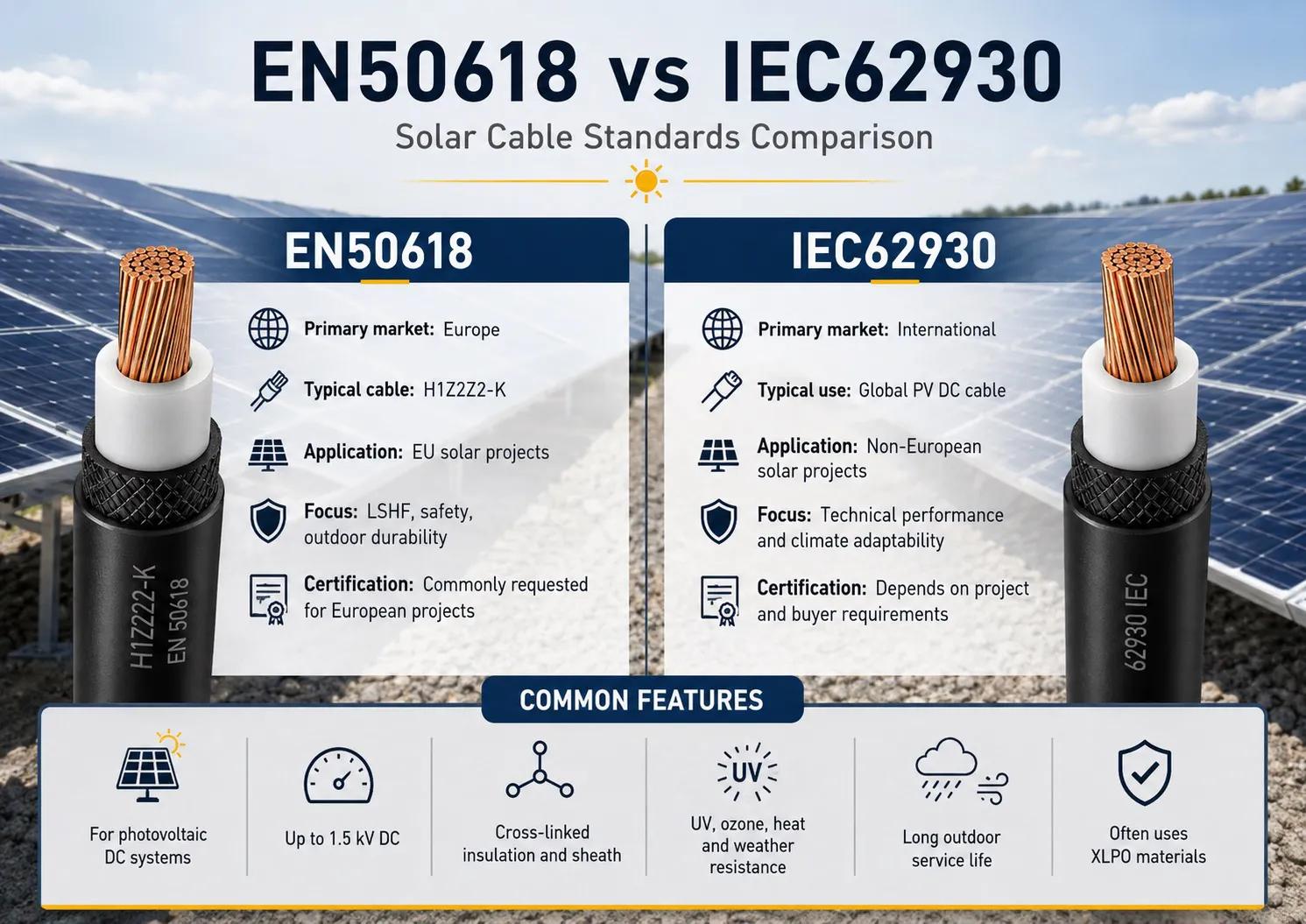
Among the most widely used standards, EN50618 and IEC62930 are two key references for solar DC cables. EN50618 is mainly used in the European market, while IEC62930 is widely accepted in global photovoltaic projects.
For buyers, contractors, and cable manufacturers, understanding the differences between these two standards helps select the right solar cable for different markets and project requirements.
EN50618 is a European standard for photovoltaic DC cables. It is commonly associated with H1Z2Z2-K solar cables, which are widely used in rooftop, commercial, industrial, and utility-scale solar projects across Europe.
This standard focuses on electrical safety, weather resistance, flame retardancy, low-smoke halogen-free performance, and long-term outdoor durability. In European projects, customers often require solar cables with third-party certification based on EN50618.
IEC62930 is an international standard for photovoltaic DC cables. It provides a global technical framework for solar cables used in different climates and installation environments.
IEC62930 is commonly used in non-European markets, including the Middle East, Southeast Asia, Africa, South America, and domestic large-scale solar power plants. It covers important performance requirements such as thermal aging resistance, UV resistance, ozone resistance, flame retardancy, and mechanical strength.
EN50618 and IEC62930 are technically close. Both standards are designed for photovoltaic DC cables used in long-term outdoor solar power systems.
They share several core requirements:
Suitable for photovoltaic DC systems, commonly including 1.5kV DC applications
High resistance to heat, UV radiation, ozone, moisture, and weather aging
Low-smoke halogen-free and flame-retardant material performance
Strong mechanical properties after aging tests
Use of XLPO cross-linked polyolefin insulation and sheath materials
Long service life under harsh outdoor environments
Because of these similarities, many cable manufacturers develop one solar cable product platform that can meet both EN50618 and IEC62930 requirements.
| Comparison Item | EN50618 | IEC62930 |
|---|---|---|
| Standard Type | European solar cable standard | International solar cable standard |
| Typical Cable Marking | H1Z2Z2-K | IEC photovoltaic cable marking |
| Main Market | Europe and EU-related projects | Global non-European PV markets |
| Certification Practice | Often requires EN50618-based third-party certification | Certification depends on buyer, project, and local market |
| Regulatory Focus | Closely related to European fire safety and environmental compliance | More focused on global technical performance |
| Application Scenario | Rooftop, commercial, and European utility PV projects | Desert, coastal, tropical, high-humidity, and large-scale solar farms |
The biggest difference is not only technical performance, but also market access. A cable that meets IEC62930 may not automatically satisfy European project requirements. For Europe, EN50618 certification is usually the safer choice.
XLPO cross-linked polyolefin is widely used for solar cable insulation and sheath. It provides excellent electrical insulation, low-smoke halogen-free performance, flame retardancy, UV resistance, ozone resistance, and long-term weather resistance.
There are two common XLPO material routes:
Irradiation cross-linked XLPO uses electron beam irradiation to complete cross-linking. It offers uniform cross-linking, excellent heat resistance, strong dimensional stability, and good long-term outdoor performance.
It is often used for high-end photovoltaic cables, especially for European export projects and applications requiring stable long-term reliability.
Silane cross-linked XLPO uses silane grafting and moisture curing. It has lower equipment investment requirements and is suitable for continuous extrusion and large-scale production.
With proper formulation, silane cross-linked XLPO can also meet EN50618 and IEC62930 requirements. It is a practical option for cost-sensitive solar cable markets.
For the European market, EN50618 should be the priority. Buyers usually prefer H1Z2Z2-K solar cables with recognized third-party certification and low-smoke halogen-free performance.
For the Middle East, Southeast Asia, Africa, South America, and domestic PV projects, IEC62930 is often used as the main technical reference. In these markets, buyers may focus more on high-temperature resistance, UV resistance, humidity resistance, and long-term outdoor durability.
For global cable manufacturers and exporters, the most efficient strategy is to develop solar cable products that can comply with both EN50618 and IEC62930. This helps reduce repeated testing costs and improves international market coverage.
If you are looking for reliable photovoltaic cables for different solar projects, Jianyun Cable provides cable solutions for power transmission, solar energy, construction, and industrial applications. Learn more about our cable products at:
https://www.jianyuncable.com
No. They are technically similar, but not identical. EN50618 is mainly used for the European market, while IEC62930 is an international photovoltaic cable standard.
Not always. For European projects, EN50618 certification is usually required or preferred. IEC62930 may be accepted in many non-European markets.
Yes. Many manufacturers design solar cables and XLPO materials to meet both EN50618 and IEC62930 requirements.
XLPO cross-linked polyolefin is widely used for photovoltaic cable insulation and sheath because of its heat resistance, UV resistance, flame retardancy, and low-smoke halogen-free properties.
No. EN50618 is a technical standard. TÜV is a third-party certification body that can test and certify solar cables according to EN50618 or other applicable standards.
EN50618 and IEC62930 are both important standards for photovoltaic DC cables. They share similar technical requirements, including electrical safety, thermal aging resistance, UV resistance, ozone resistance, flame retardancy, and XLPO material performance.
However, they are not completely interchangeable. EN50618 is more closely connected with European market access, while IEC62930 is widely used for international photovoltaic projects.
For solar project buyers and cable exporters, choosing cables that meet the right standard is essential for safety, compliance, and long-term performance. For dependable cable solutions, visit Jianyun Cable at https://www.jianyuncable.com.
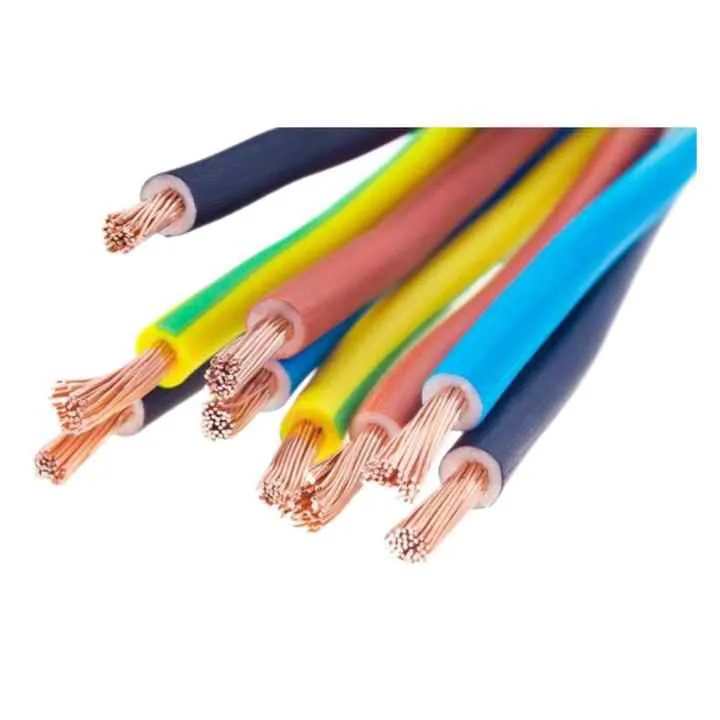
Flexible copper electrical wire with stranded copper conductor, PVC insulation a
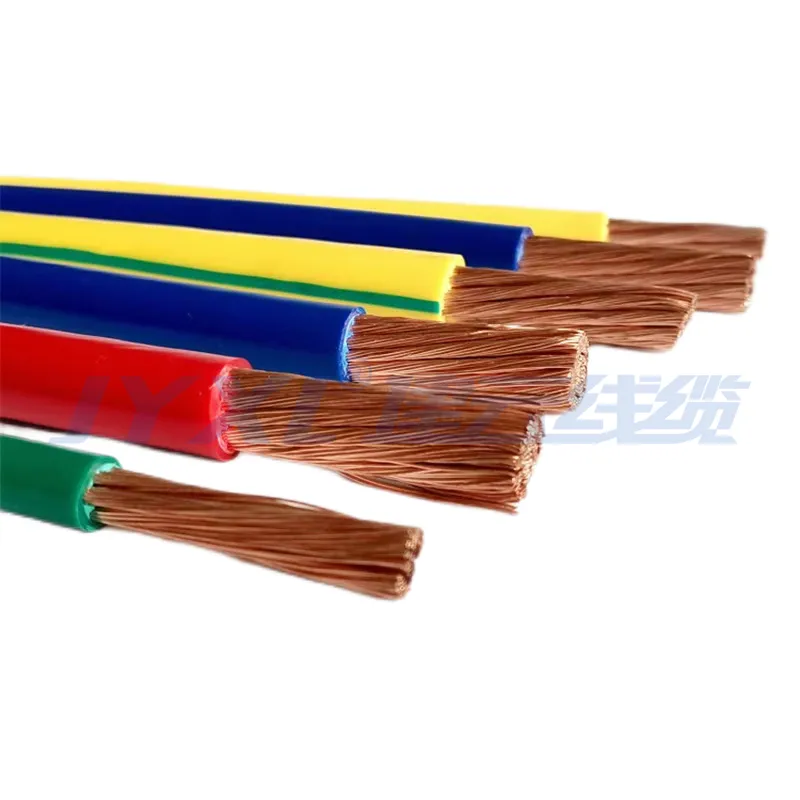
H07V-K flexible electrical wire with 1.5mm² and 2.5mm² stranded copper conductor
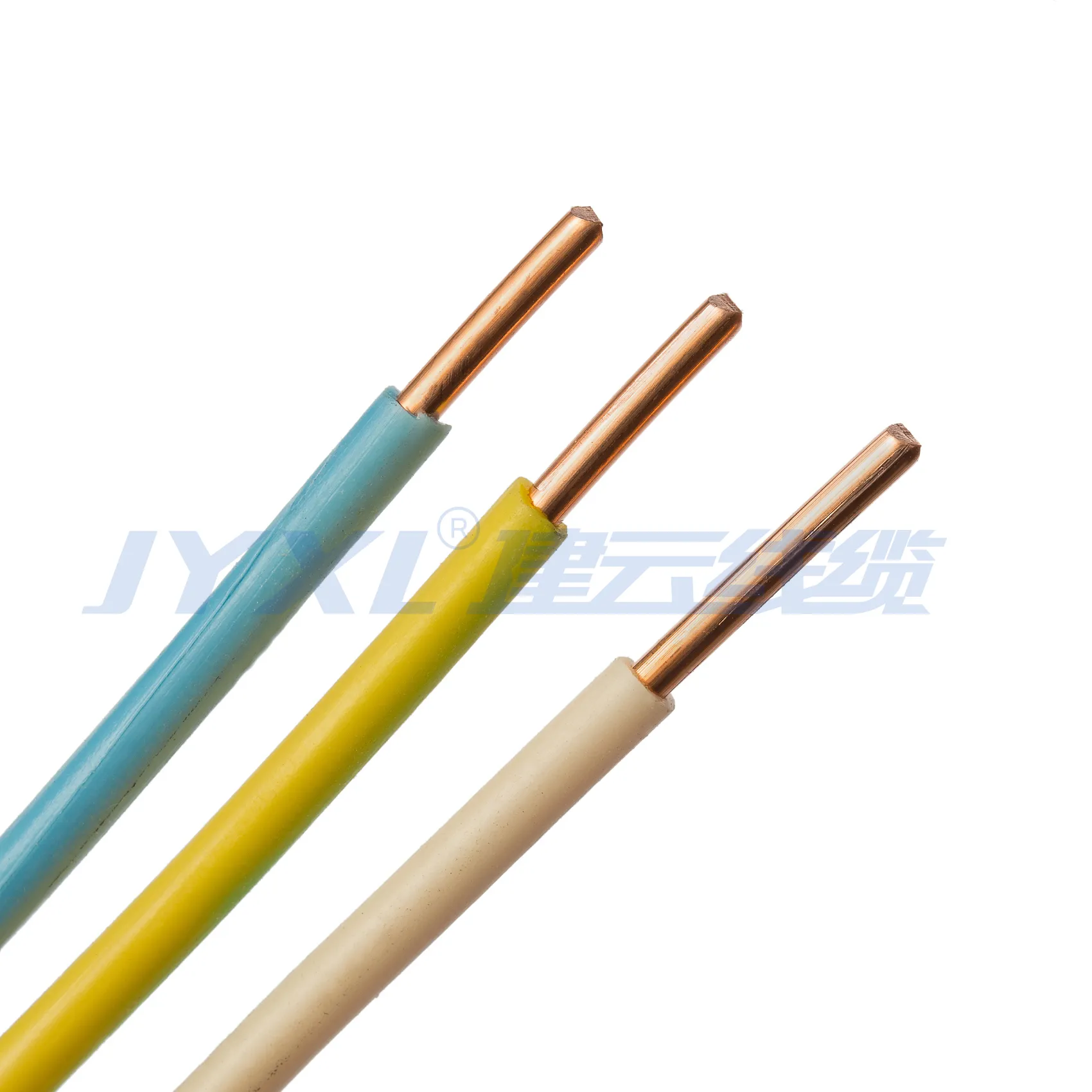
Jianyun H07V-U Solid Copper PVC Wire is a single core rigid electrical wire manu
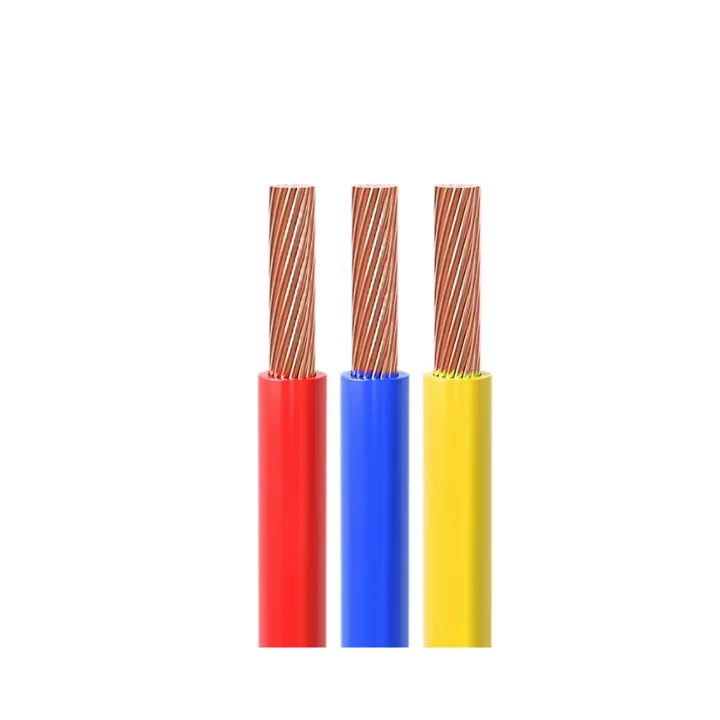
CE Certification 450/750v H07VVF Flexible Copper PVC Insulated Ac Cable 3*2.5 Mm