Keep up to date with our latest company news and relevant industry knowledge.
Time: 2026-09-14 06:48:12 Source: Henan Province Jianyun Cable Co., Ltd.
Cable Knowledge Series
Every solar panel string relies on a short, single-core wire that rarely gets discussed — but its color, size and grounding configuration quietly shape how the whole system behaves.
Most conversations about solar wiring focus on the big picture — panels, inverters, combiner boxes. But zoom in on the connection points between individual modules, and you'll find a much smaller, quieter component doing essential work: PV interconnection wire, a single-core wire that links modules together and forms the string.
It looks simple, but its color coding, grounding configuration and construction are far from arbitrary. This guide unpacks what makes interconnection wire different from general solar cable, and why those small details matter.
Solar cable comes in a few different shapes depending on where it sits in the system:
Interconnection wire sits at the very start of this chain — it's the first wire the current touches as it leaves the solar module, which is exactly why its construction gets so much attention.
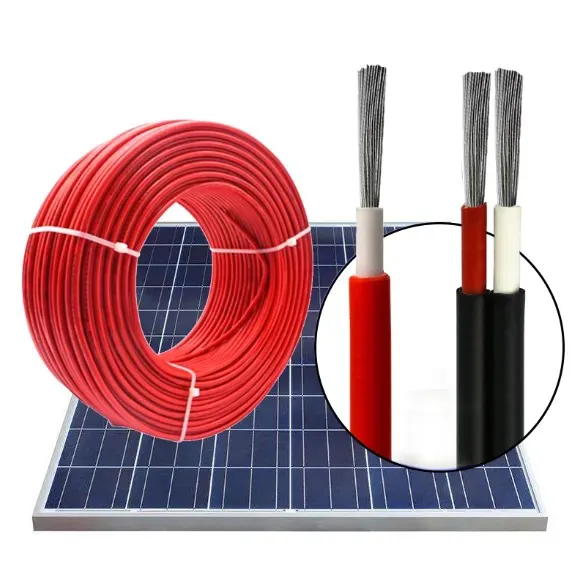
Photovoltaic systems are generally designed as either grounded or ungrounded, and interconnection wire needs to suit both:
| System Type | What It Means | Wiring Implication |
|---|---|---|
| Grounded system | One current-carrying conductor (typically negative) is intentionally connected to earth ground | Requires clear conductor identification and insulation rated for the system's grounding scheme |
| Ungrounded system | No current-carrying conductor is intentionally grounded; both positive and negative float relative to earth | Requires double or reinforced insulation on every conductor, since either one could become energized relative to ground under a fault |
This is exactly why quality PV interconnection wire is typically built with double-layer cross-linked insulation — it needs to perform reliably in both grounded and ungrounded configurations without the installer needing a different product for each.
| Color | Typical Role |
|---|---|
| Black | Commonly used for the positive or ungrounded conductor, depending on local code |
| Red | Often marks the positive conductor in many installation conventions |
| Blue | Frequently used to identify a grounded/negative conductor where relevant |
Exact color conventions vary by country and installer practice, which is exactly why consistent labeling on every string — and following the specific project's electrical drawings — matters more than assuming a universal standard.
| Property | Typical Value |
|---|---|
| Conductor | Tinned fine copper strands, Class 5 per IEC 60228 |
| Insulation | Cross-linked polyolefin (XLPO), double-insulated, halogen-free, flame retardant |
| Rated Voltage | AC 0.6/1kV, DC 0.9/1.8kV (max. permitted DC 1.8kV, non-earthed) |
| Conductor Temperature | Up to 120°C maximum; ambient rating -40°C to 90°C |
| Short-Circuit Temperature | 200°C for a maximum of 5 seconds |
| Expected Service Life | Around 25 years under rated conditions |
| Common Standards | TUV 2PfG 1169, UL 4703, EN 50618, tested per EN 50395/50396 |
Q: Can the same interconnection wire be used for both grounded and ungrounded systems?
A: Yes, wire built with double or reinforced cross-linked insulation is generally suitable for both configurations, which is why it's a common default choice for module-level wiring.
Q: Does wire color affect performance?
A: No — color is purely for identification and doesn't change the wire's electrical performance, though consistent color use is important for safe, easy troubleshooting.
Q: Why is the conductor tinned rather than plain copper?
A: Tinning helps protect the fine copper strands from oxidation over the wire's long outdoor service life, which matters given how many decades a solar installation typically stays in service.
Q: What gauge of interconnection wire do most residential solar systems use?
A: 12AWG and 10AWG are common choices for typical residential module strings, though the correct size always depends on the specific module's rated output current and the installation's voltage drop requirements.
Q: Is interconnection wire the same thing as MC4 cable?
A: They're closely related — interconnection wire is often what's inside a pre-terminated MC4 whip or assembly, though the wire itself and the connector are technically separate components that need to be compatible.
PV interconnection wire rarely gets the spotlight, but it's the first link in every solar string's electrical path — and its color, grounding compatibility and construction quietly determine how safely and reliably that path holds up over 25 years of sun, heat and weather. Getting these small details right at the module level is just as important as any decision made further down the line at the inverter.

